Caral: a wider map of early urban life
Caral shows that early urban life was not confined to one region. A shared timeline lets us compare societies without inventing contact between them.
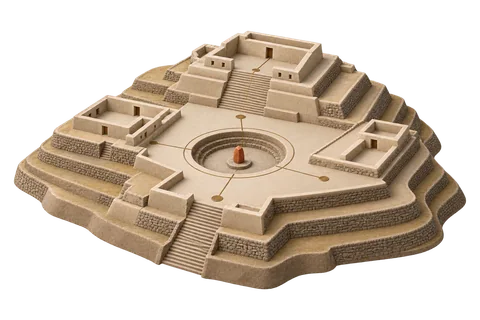
Where Caral grew
UNESCO describes Caral-Supe as an early urban center in Peru's Supe Valley, with monumental platform mounds and sunken circular courts. Its account places the site's development broadly between 3000 and 1800 BCE, citing radiocarbon evidence. UNESCO World Heritage Centre ↗
Read a date as a range
A broad period helps orient a reader; it does not mean every building or activity has the same date. Compare the source's dating discussion with its architectural description before turning a range into a precise event.
Compare without inventing a route
Putting two societies on the same timeline can reveal a useful question. A claim that they exchanged ideas needs its own evidence: a route, a material trail, a text, or another defensible connection. Shared dates alone do not supply that connection.
Continue the investigation
Use the UNESCO description as an orientation point, then open the site's nomination materials for more detail. Keep the geographic setting and the evidence for chronology beside the story you are building.