Sumer: how scholars divide its early history
The Square Temple at Tell Asmar helped define the Early Dynastic period. The boundaries of its stages remain debated.
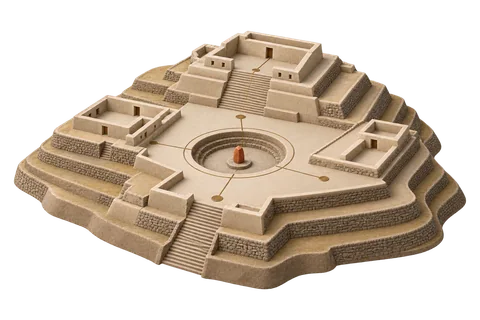
The Square Temple and the period’s boundaries
Evans's 2007 article in the American Journal of Archaeology examines the Square Temple at Tell Asmar and the construction of Early Dynastic Mesopotamia, framed at about 2900 to 2350 BCE. The article critically examines how the period's subdivisions were defined from this excavation. American Journal of Archaeology ↗
A range for framing
Pollock's Ancient Mesopotamia, which surveys lowland Mesopotamia from about 5000 to 2100 BCE, is cited alongside the article for the wider chronology. The research record uses 2900 to 2350 BCE as period framing, not as proof that every subdivision within it is secure. Cambridge University Press ↗
Who defined this period?
Periods are tools made by scholars from excavated sequences. When you meet a label like Early Dynastic I, II, or III, ask which site's stratigraphy defined it and whether later work has confirmed or questioned that division.
Can this scheme work at another site?
If one influential excavation shaped the whole period scheme, how would you test the scheme against a different site?