Gonur Depe and the Oxus civilization: a Bronze Age world with two clocks
The largest site of the Oxus civilization has two published timelines. Compare their evidence before assigning a single date to the whole culture.
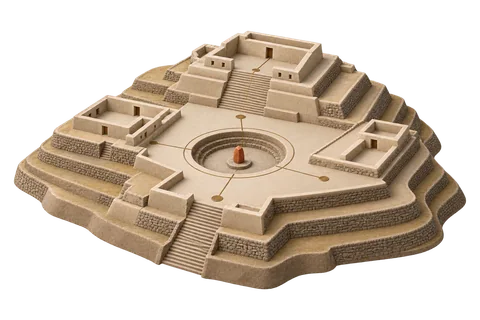
Where the Oxus civilization lived
Lyonnet and Dubova's overview of the Oxus civilization, also called the Bactria-Margiana Archaeological Complex, frames its main span at about 2250 to 1700 BCE, with a later decline toward 1500 BCE. The synthesis emphasizes where radiocarbon dates concentrate and notes the absence of earlier urban architecture at major sites. Routledge ↗
An alternative model
Salvatori's study of a grave in the royal graveyard at Gonur proposes a Middle Bronze Age integration horizon beginning earlier, around 2400 or 2300 BCE, and ending near 1950 BCE. The research record keeps this as an alternative periodization rather than letting either model silently replace the other. On the Track of Uncovering a Civilisation — volume honoring Victor Sarianidi ↗
Compare the phases before the dates
Two ranges for one civilization usually signal different phase definitions or different site samples. The decision rule used here is to compare phase definitions, site scope, and radiocarbon series before choosing, and never to average the ranges.
What new samples would settle the timeline?
What would a single new radiocarbon series need to show to favor one model? Think about which sites and which phases it would have to cover.